

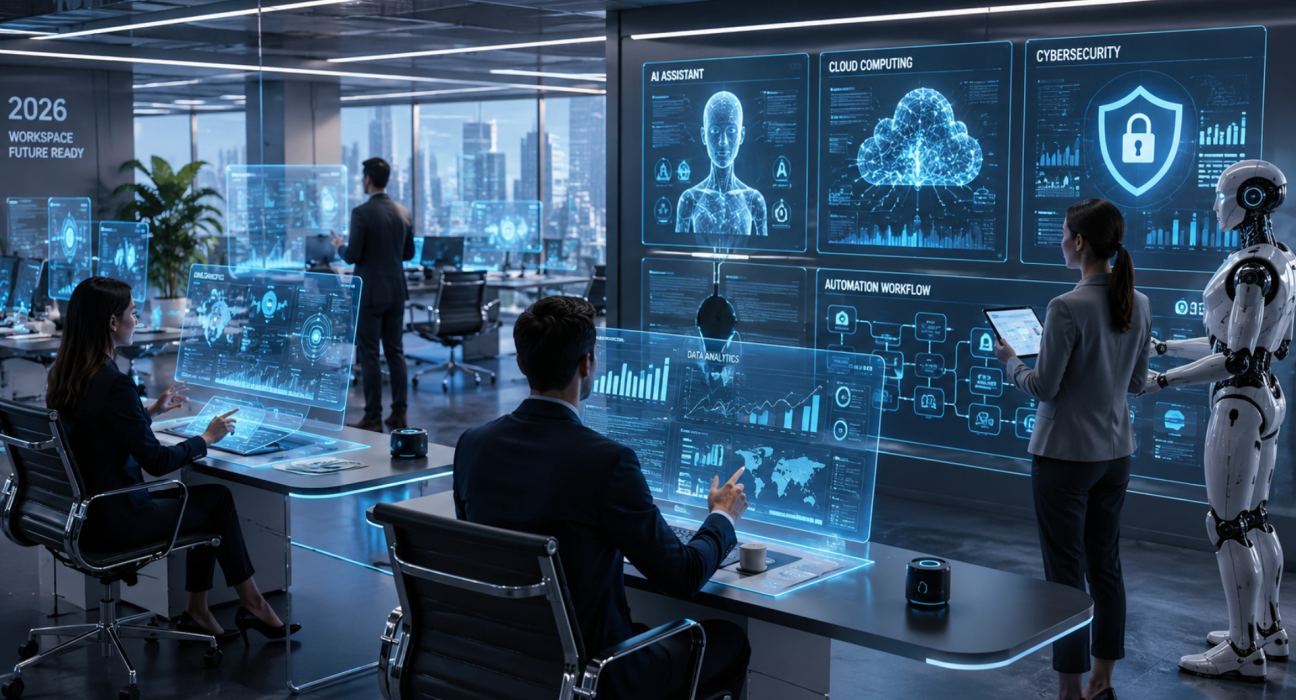
There is no better year than 2026 which is witnessing a wave of innovative technology. Artificial intelligence is gaining smartness, companies are automating at large scale, cybersecurity is in a new phase, and green technology has become increasingly popular globally. Not only are these advancements transforming industries, but also our working, learning, communication and life.
No matter what your status is, be it a student, an entrepreneur, business owner or a technology enthusiast, keeping up with the new trends in technology will equip you with an opportunity to deal with future opportunities and challenges. In this article, we’ll explore the top technology trends in 2026 that are expected to shape the future and redefine our digital world.
1. AI Agents Are Made Everyday Digital Assistants.
The world of Artificial Intelligence has been ruling the technological arena, although a significant change in the form of basic chatbots to intelligent AI agents is being experienced in 2026.
AI agents have the ability to execute complex tasks without the need to be asked a question, unlike traditional AI tools. They are able to organize a meeting, analyze business reports, work with emails, create content, write code and even make decisions according to the preferences of users.
Companies are progressively incorporating AI agents in customer care, finance, health, marketing and software development. With such systems being more dependable, companies are saving time and enhancing productivity.
Key Benefits
- Faster workflow automation
- Personalized customer experiences
- Improved business efficiency
- Reduced operational costs
2. Generative AI Goes Mainstream
Generative AI is not only growing in text generation. Organizations are utilizing AI to produce images, videos, music, presentations, marketing campaigns, and software applications in 2026.
AI tools are no longer substitutes but complements to content creators, educators, designers, and developers in improving creativity.
Some of the industries that should take advantage of Generative AI are:
- Digital Marketing
- Education
- Healthcare
- Gaming
- Entertainment
- Software Development
- E-commerce
To create high-quality content in a matter of seconds as never before, businesses are investing in AI-powered creative solutions to achieve this.
3. Quantum Computing is a Reality that is Getting Closer.
The idea of quantum computing has been around for a long time, but 2026 represents a big step forward in making quantum computing a reality.
In contrast to classical computers, quantum computers operate based on quantum bits (qubits), which can enable them to solve some problems much faster.
Potential applications include:
- Drug discovery
- Climate modeling
- Financial forecasting
- Logistics optimization
- Advanced scientific research
- Cryptography
The quantum research investments made by governments and big tech continue to bring out billions of dollars, although it might still be a long time before it is widely adopted.
4. Artificial Intelligence-based Cybersecurity.
Due to the increasingly advanced cyber threats, organizations are increasingly considering AI-driven cybersecurity solutions.
The smart security systems no longer wait until attacks occur but rather they anticipate, identify and act on threats in real time.
Some of the key trends in cybersecurity are:
- AI threat detection
- Zero Trust Security
- Multi-factor authentication
- Biometric authentication
- Cloud security automation
- Real-time threat intelligence
As the number of ransomware attacks and data breaches continues to rise worldwide, cybersecurity is now among the top priorities of businesses in 2026.
5. Edge Computing Grows at a Lightpace.
Conventional cloud computing is used to transmit data to central servers to process the data. Edge computing alters this by computing data nearer to the source of data.
This reduces:
- Latency
- Bandwidth usage
- Response time
Examples of industries using edge computing are:
- Healthcare
- Manufacturing
- Smart Cities
- Autonomous Vehicles
- Retail
- Telecommunications
Since the number of IoT devices is still increasing, it is necessary to have edge computing to provide real-time performance.

6. Internet of Things (IoT) Is Smarter.
The Internet of Things is becoming more intelligent thanks to AI integration.
Smart devices have been able to communicate with one another as well as make autonomous decisions without human involvement.
Examples include:
- Smart homes
- Connected factories
- Wearable fitness devices
- Smart agriculture
- Intelligent traffic management
- Industrial automation
IoT assists companies to work more effectively and offer users more personal experiences.
7. Sustainable Innovation and Green Technology.
The issue of climate is driving organizations towards eco-friendly technologies.
Having a green footprint is becoming a major concern among companies in the year 2026 through sustainable innovation.
New green technologies are:
- Energy-efficient data centers
- Electric vehicles
- Renewable energy systems
- Smart energy grids
- Carbon capture technologies
- Eco-friendly manufacturing
Green technology has become an environmental and business priority as consumers are more likely to choose companies that are devoted to sustainability.
8. Robotics and Automation keep changing Industries.
Automation is no longer just confined to manufacturing.
Robots are now helping in:
- Warehousing
- Healthcare
- Agriculture
- Hospitality
- Logistics
- Food production
Collaborative robots (cobots) collaborate with humans, enhancing productivity as well as minimizing manual repetitive activities.
Automation with businesses leads to enhanced precision, reduced expenses and increased efficiency in business operations.
9. Extended Reality (XR) Takes Off.
Extended Reality combines:
- Virtual Reality (VR)
- Augmented Reality (AR)
- Mixed Reality (MR)
In 2026, there are advancements in XR technologies:
Education
Students are exposed to virtual interactive classrooms.
Healthcare
Surgery simulation enables doctors to train on complicated procedures.
Retail
Shoppers test product virtually prior to purchase.
Manufacturing
AR glasses can provide workers with real-time maintenance instructions.
XR is revolutionizing learning, training, entertainment, and customer interaction.
10. 6G Research Accelerates
Although most areas still develop 5G networks, scientists already work on 6G technology.
Expected benefits include:
- Ultra-fast internet speeds
- Near-zero latency
- Better IoT connectivity
- Enhanced smart cities
- Improved autonomous transportation
- Advanced remote healthcare
Though a commercial deployment is not a possibility yet, it is projected that a lot of 6G research will be made in the year 2026.
The effects of these technology trends on businesses.
Organizations that adopt new technologies have a competitive edge.
Businesses can expect:
- Increased productivity
- Better customer experiences
- Smarter decision-making
- Reduced operating costs
- Enhanced cybersecurity
- Faster innovation
- Improved sustainability
Firms that are slow in digital transformation might not be able to stay competitive in fast changing markets.
Skills to Learn in 2026.
With the changing technology, skills should be regularly updated by the professionals.
Industries of some of the most valuable technology capabilities are:
- Artificial Intelligence
- Machine Learning
- Cloud Computing
- Cybersecurity
- Data Analytics
- Prompt Engineering
- Python Programming
- Automation Tools
- Digital Marketing
- DevOps
- UI/UX Design
- Blockchain Fundamentals
Life-long learning will be a vital part of professional development in the technological sector.
Final Thoughts
Smart automation, AI-driven solutions, green innovation, new cybersecurity, quantum computing, and integrating digital ecosystems all shape the technology scene in 2026. These inventions are also changing the way business is done, new job opportunities are created and the way of life is changing day to day lives in amazing ways.
Although not all of the new technologies will become widely used right now, the trend is evident: smarter, faster, and more interconnected systems will become the future. The people and companies that will succeed in the future are those that will engage in lifelong learning and adapt to such trends.
Instead of perceiving these technologies as remote opportunities, it is time to see what they can do, develop the appropriate skills and be ready to enter a new era where innovation will be the driving force behind all that can be done in society.
Frequently Asked Questions (FAQs)
1. What is the largest technology trend in 2026?
Artificial Intelligence, specifically AI agents and Generative AI is believed to be the largest trend in technology as it is revolutionizing almost all industries by automating, increasing productivity and making smart decisions.
2. Why is cybersecurity more important in 2026?
With a greater dependency on cloud services, AI, and connected devices, cyber threats have become more advanced. High-level cybersecurity assists in safeguarding confidential information, avoiding attacks, and business continuity.
3. What is the difference between quantum computing and traditional computing?
Quantum computers do not utilize classical bits but rather qubits which enable quantum computers to solve some complex problems at a much higher rate compared to the conventional computers. They have the potential to revolutionize scientific research, finance, and healthcare.
4. Which industries will be the most benefited by these trends in technology?
The new technologies in 2026 are likely to have a positive impact on healthcare, finance, manufacturing, education, retail, logistics, transportation, agriculture and software development.
5. What tech skills do I need to acquire to be competitive in 2026?
Some of the most in-demand skills include Artificial Intelligence, Machine Learning, Cloud Computing, Cybersecurity, Data Analytics, Python Programming, Prompt Engineering, DevOps, and Automation.
6. Is 6G available in 2026?
No. Although research and testing is advancing at an alarming pace, 6G is still in the development stages. The majority of nations are still building 5G networks and are laying the groundwork in anticipation of the 6G rollout.
7. What can businesses do to get ready to emerging trends in technology?
To be competitive, businesses must make investments in digital transformation, embrace AI-driven tools, enhance cybersecurity, educate employees on new technology, and focus on sustainable innovation.