

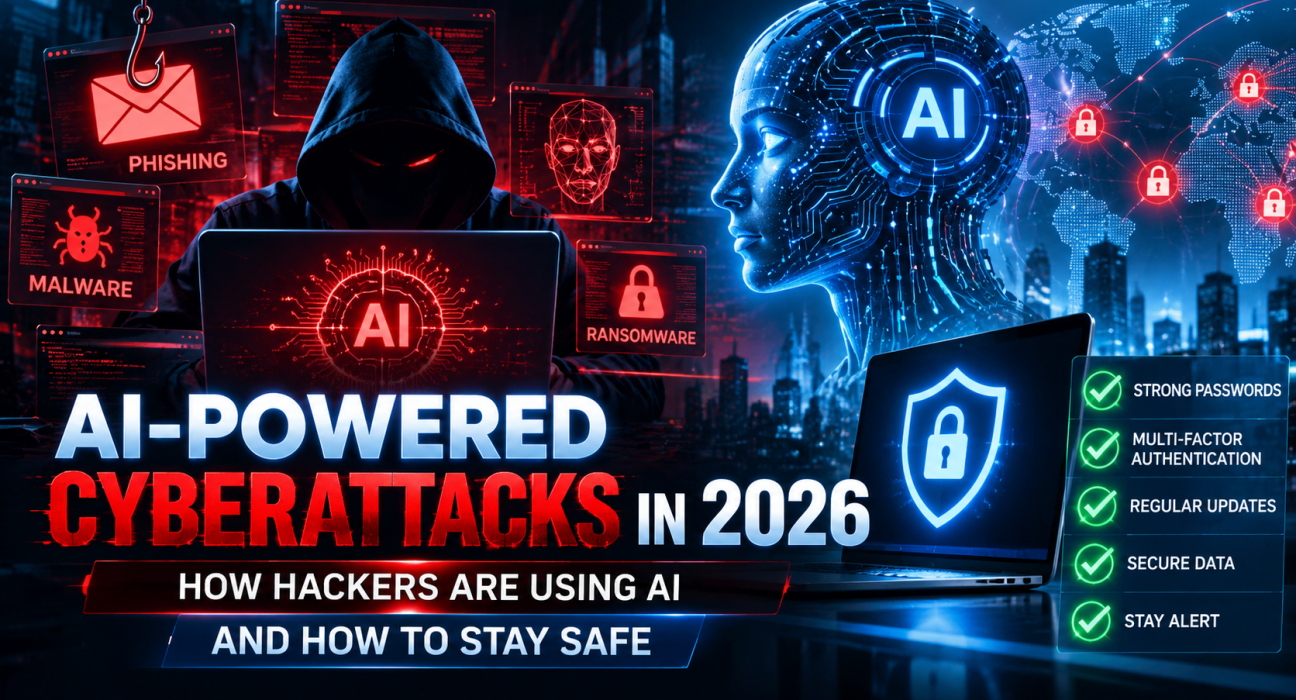
Artificial intelligence is changing cybersecurity faster than many businesses expected. From convincing phishing emails to automated vulnerability discovery, AI-powered cyberattacks are creating new challenges for organizations, financial institutions, and everyday internet users. Hackers can use AI tools to speed up tasks that previously required more time and technical knowledge, making digital security an increasingly important priority.
Recent incidents involving South Korean financial institutions have brought this concern into focus. In October 2026, reports described suspected AI-assisted cyber activity targeting multiple banks, raising questions about how attackers are using AI agents to identify weaknesses and potentially expose customer information. Reuters reported on the investigation and suspected use of AI tools.
Could your business be the next target of an AI-powered cyberattack?
Understanding how these attacks work can help you recognize suspicious activity, protect sensitive information, and respond before a small security weakness becomes a serious problem. Here is what you need to know about the latest developments and the practical steps you can take to stay safe.
What Are AI-Powered Cyberattacks?
AI-powered cyberattacks are cyber threats in which attackers use artificial intelligence to support activities such as researching targets, generating deceptive messages, analyzing potential weaknesses, or automating parts of an attack.Traditional cyberattacks can already cause significant damage, but AI may help attackers complete certain tasks faster and adapt their techniques to different targets. For example, a criminal might use an AI tool to draft a convincing email that imitates a supplier, summarize publicly available information about a company, or help analyze software vulnerabilities.
However, AI does not automatically make every attack successful. Attackers still need an opportunity to exploit a weakness, deceive a victim, or gain unauthorized access. Strong security controls can prevent many attacks, whether AI is involved or not.Organizations should also remember that AI has legitimate security applications. Security teams can use AI-assisted tools to analyze alerts, identify unusual activity, and prioritize potential vulnerabilities.
Latest Cybersecurity Developments: AI and Banking Security
Recent events demonstrate Why AI-related cyber risks deserve attention?
On October 8, 2026, Reuters reported that Crowd Strike had identified a suspected individual behind cyberattacks targeting at least nine South Korean banks. Investigators described the suspected use of an AI agent and other AI tools during the activity. The reported incidents included the exposure of customer information at affected financial institutions.
The investigation highlights a potential shift in the cybersecurity landscape: one attacker using automation may be able to investigate or target multiple systems in less time than would otherwise be possible. Attribution remains an investigative matter, and reports about a suspected attack should not be treated as proof of every allegation.
Read the Reuters report on the suspected AI-assisted attacks against South Korean banks for further details.
The incident also highlights the importance of securing third-party services, customer portals, and systems connected to an organization’s main network. A business does not need to experience a direct attack on its core infrastructure to suffer a data breach.
How Hackers Are Using AI to Launch Cyberattacks
1. Creating More Convincing Phishing Emails
Phishing remains a major cybersecurity concern. Attackers use deceptive emails, messages, and websites to persuade people to reveal passwords, approve payments, or download malicious files.
AI can help generate professional-looking messages with fewer spelling mistakes and more personalized details. An email may appear to come from a manager, bank, delivery company, or trusted business partner.
Employees should verify unexpected requests involving payments, credentials, confidential files, or urgent account changes. When a message asks for sensitive action, confirm it through a separate, trusted communication channel rather than relying on the message itself.
2. Identifying Potential Software Weaknesses
Attackers may use AI-assisted tools to examine code, interpret technical information, and identify possible security weaknesses. These capabilities can also help authorized security researchers discover and fix vulnerabilities.
The main concern is what happens when such tools are used without permission. Businesses should maintain an accurate inventory of their systems, apply security updates promptly, and conduct authorized security testing.
For a broader overview, explore ITAdvice’s article on 10 Common Types of Cyberattacks and How to Prevent Them.
3. Automating Repetitive Attack Tasks
AI agents can help automate certain digital tasks, including gathering information, analyzing results, and coordinating workflows. In a malicious setting, automation may allow attackers to investigate more potential targets or adapt their methods more quickly.
This does not mean that AI agents can break into every system independently. Their capabilities depend on their tools, permissions, available information, and the security barriers they encounter.
Organizations should monitor unusual activity, restrict unnecessary access, and investigate repeated login failures, unexpected system changes, or suspicious requests to sensitive services.
4. Creating Deepfakes and Impersonating Trusted People
AI-generated audio, images, and video can make impersonation attempts more convincing. A criminal might pretend to be an executive requesting an urgent bank transfer or a colleague asking for confidential information.
Voice recognition alone should not be treated as sufficient proof of identity. Businesses should establish payment verification procedures, approval requirements, and callback policies for unusual financial requests.
Employees should also understand that an urgent tone, familiar voice, or realistic-looking video does not automatically establish that a request is genuine.
Seven Ways to Protect Yourself From AI-Powered Cyberattacks
Recognizing the risks is only the first step. These seven measures can strengthen your cybersecurity without requiring every organization to purchase an expensive security platform.
1. Enable Multi-Factor Authentication
Multi-factor authentication (MFA) adds another verification step beyond a password. Depending on the service, this might involve an authenticator app, security key, or another supported method.
Enable MFA on email accounts, banking services, cloud platforms, and administrator accounts. Prefer phishing-resistant security keys or passkeys where available, particularly for accounts with access to sensitive information.
2. Use Strong, Unique Passwords
Reusing passwords creates unnecessary risk. If one service is compromised, attackers may try the same credentials on other websites.
Use a reputable password manager to generate and store unique passwords. Never share authentication codes or approve unexpected login requests simply because a message claims your account will be suspended.
3. Update Software and Devices Promptly
Outdated operating systems, plugins, applications, and network devices may contain known vulnerabilities that attackers can exploit.
Enable automatic updates where appropriate, prioritize security patches for internet-facing systems, and remove software that is no longer needed. Businesses should maintain a documented patching process rather than relying on occasional manual checks.
4. Train Employees to Recognize Suspicious Messages
Security awareness training should cover phishing, impersonation, suspicious attachments, fake login pages, and unusual requests for confidential information.
Use realistic examples and explain how employees can report potential incidents. Staff should feel comfortable checking an unusual request with a manager instead of rushing to meet an artificial deadline.
5. Back Up Important Data
Regular backups can reduce the impact of ransomware, accidental deletion, and certain other incidents.
Keep protected backups separate from everyday systems, restrict who can modify them, and test restoration procedures regularly. A backup is only useful if the organization can recover its information when needed.
6. Restrict Access to Sensitive Systems
Every employee and application should have only the permissions necessary to perform its role. This principle, known as least privilege, limits the potential damage if an account or automated tool is compromised.
Review administrator accounts, remove access when employees leave, and require additional approval for sensitive operations. Businesses adopting AI agents should also limit their access to files, credentials, and external services.
7. Monitor Systems and Prepare an Incident Response Plan
Organizations should monitor login activity, network traffic, endpoint alerts, and changes to critical systems. Security tools can help identify suspicious behavior, but alerts still require appropriate investigation.
Create a response plan that explains who should be contacted, how affected systems will be isolated, how evidence will be preserved, and when customers or relevant authorities must be notified.
Test the plan before an incident occurs. Knowing who makes decisions during an emergency can save valuable time.
How AI Can Help Defend Against Cyberattacks
AI is not only a tool for attackers. When implemented carefully, AI-assisted security systems can help defenders process large volumes of information, identify unusual patterns, summarize alerts, and prioritize potential threats.
For example, an AI-assisted monitoring system might flag a login from an unusual location followed by suspicious access to sensitive files. A security analyst can investigate the event, verify whether the activity is legitimate, and take appropriate action.
However, AI-generated alerts can be inaccurate, and automated responses can disrupt legitimate business operations if they are poorly configured. Human oversight, reliable data, access controls, and regular testing remain essential.
Organizations exploring these technologies can learn more in ITAdvice’s article on AI Threat Detection and Incident Response.
The most effective approach combines established security practices with carefully managed automation. AI should strengthen a well-designed security program, not replace basic controls or responsible decision-making.
What Should Businesses Do Next?
Businesses should begin by identifying their most important systems and the information they need to protect. Email accounts, customer databases, payment systems, employee credentials, and third-party applications are useful starting points for a security review.
Next, evaluate whether access controls, MFA, software updates, backups, and monitoring are working as intended. Organizations that use AI tools should also review what information those tools can access, how data is handled, and whether their permissions can be restricted.
Small businesses do not necessarily need a large security team to begin improving their defenses. A documented process, consistent updates, employee awareness, and a reliable backup strategy can make a meaningful difference.
Cybersecurity also offers opportunities for professionals who want to build careers in threat analysis, security operations, incident response, and risk management. Readers interested in this field can explore Is Cybersecurity a Good Career in 2026? Discover the Future of Tech Jobs.
Frequently Asked Questions
Are AI-powered cyberattacks more dangerous than traditional attacks?
AI can help attackers automate tasks and create more convincing scams, but the level of risk depends on the target, the attack method, and the security measures in place. Traditional attacks remain a serious threat.
Can AI prevent cyberattacks completely?
No. AI-assisted security tools can help detect suspicious activity and prioritize threats, but they cannot guarantee complete protection. Strong access controls, patching, backups, monitoring, and human oversight remain necessary.
What is the easiest way to improve cybersecurity today?
Start by enabling multi-factor authentication, using unique passwords, installing security updates, and backing up important files. These practical steps can reduce several common security risks.
How can small businesses defend against AI-powered attacks?
Small businesses should secure email accounts, train employees, restrict access to sensitive data, maintain tested backups, and establish a clear process for reporting suspicious activity. Professional security support can help address more complex risks.
Conclusion
AI-powered cyberattacks are an evolving cybersecurity challenge, and recent reports involving financial institutions show why businesses should take the issue seriously. AI can help criminals improve phishing campaigns, analyze potential weaknesses, and automate parts of their operations, but it can also support security teams in detecting and responding to threats.
The most important response is preparation rather than panic. By securing accounts, updating software, training employees, protecting backups, and monitoring critical systems, organizations can improve their resilience against both AI-assisted and traditional attacks.
As cybersecurity technology continues to develop, businesses that combine practical security controls with informed use of AI will be better positioned to protect their data, customers, and digital operations.