

How AI Will Change the Way We Work in 2026: Trends, Jobs, and the Future
- July 14, 2026
- 0
Artificial Intelligence or AI is not something you see in movies anymore. It is a part of how businesses work how employees do their jobs and how industries


9621 Agnes Crossing, Lake Suzanneview, New Mexico Island 84604-9295.
Artificial Intelligence or AI is not something you see in movies anymore. It is a part of how businesses work how employees do their jobs and how industries
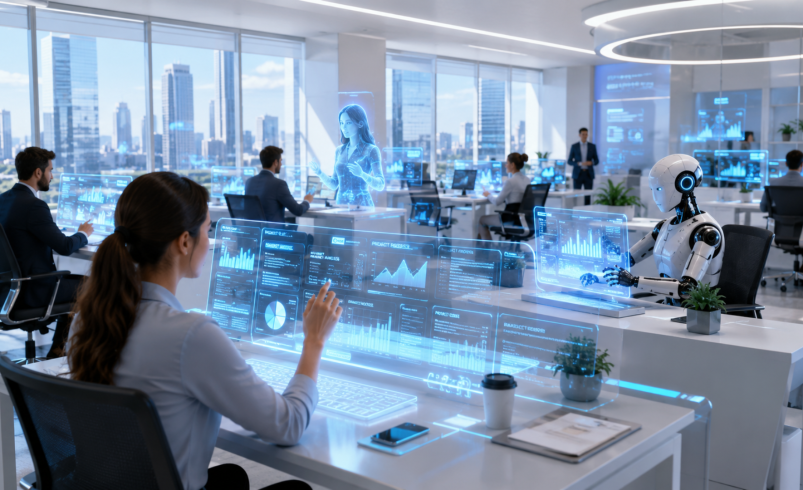
Artificial Intelligence or AI is not something you see in movies anymore. It is a part of how businesses work how employees do their jobs and how industries come up with new ideas. As we go through 2026 AI is changing workplaces faster than before. AI is doing things like automating tasks that used to be done by people helping make decisions and even creating new jobs.
AI is changing the future of work in every sector. By replacing people AI is becoming a powerful tool that helps people work smarter and faster. Companies are spending a lot of money on AI technology to get work done save money and make customers happier. At the time professionals are learning new digital skills to stay competitive in a job market that is driven by AI.
In this article we will talk about how AI will change the way we work in 2026. We will look at the trends that are driving this change, the jobs that will be affected the most new career opportunities that are coming up and practical ways to get ready for the future.
With the help of AI models, automation software and intelligent assistants we can now do tasks that used to take a lot of time and effort.
Companies are using AI because it can:
Give customers personalized experiences
In 2026 AI is not just about replacing employees but about making their work better.
AI assistants are now used in every workplace.
Employees use AI to:
Instead of spending hours on administrative work professionals can focus on strategy, creativity and innovation.
Automation is not just limited to manufacturing
Companies are now automating:
This trend, known as hyperautomation combines AI, machine learning and robotic process automation to make entire business workflows better.
AI is revolutionizing the way we learn at work.
Of generic training courses AI creates personalized learning paths based on an employees:
Employees get customized recommendations that help them learn faster and improve continuously.
Executives are increasingly using AI to look at market trends customer behavior, financial forecasts and operational risks.
AI can find patterns that humans might miss helping businesses make decisions based on real-time data.
AI has become a tool at work.
Professionals are using AI to create:
By replacing creativity AI is making the creative process faster.
As cyber threats get more sophisticated AI is playing a role in keeping organizations safe.
AI systems can:
Cybersecurity professionals are working alongside AI-powered security systems.

Doctors are using AI to:
Healthcare professionals are spending time on paperwork and more time taking care of patients.
Teachers are using AI for:
Students are benefiting from learning experiences tailored to their individual needs.
Banks and financial institutions are using AI for:
Financial professionals are using AI to improve accuracy and reduce work.
AI is helping marketers:
Marketing teams can focus more on strategy while AI handles optimization tasks.
Factories are increasingly using AI-powered robots for:
Human workers are supervising systems instead of doing repetitive physical tasks.
AI will affect almost every profession but not all jobs will change equally.
Some roles that will experience transformation include:
These jobs will not disappear overnight but many routine tasks within them will become automated.
As AI changes workplaces it is also creating new career opportunities.
Some of the growing AI-related jobs include:
Professionals who design prompts to get the best results from AI systems.
Experts who improve AI performance by providing feedback and training data.
Responsible for ensuring AI systems remain fair, transparent and responsible.
Develops systems capable of learning from data.
Leads the development of AI-powered products and business solutions.
Protects AI systems from cyber threats and malicious attacks.
Helps organizations workflows using AI technologies.
Success in 2026 depends less on memorizing information and more on working effectively alongside AI.
AI provides information. Humans still make strategic decisions.
Creative problem-solving remains difficult for AI to replicate.
Strong communication skills become more valuable in AI-assisted workplaces.
Leadership, empathy, teamwork and relationship-building remain uniquely strengths.
Understanding data helps employees make use of AI-generated insights.
Every professional should understand:
Companies that adopt AI report many advantages.
Employees complete tasks with AI assistance.
AI analyzes amounts of data within seconds.
Automation reduces expenses.
AI provides recommendations and faster service.
Teams spend time on repetitive work and more time developing new ideas.
Employees can automate tasks allowing them to focus on meaningful work.
Despite its benefits AI also introduces challenges.
Some repetitive jobs may decline as automation increases.
However many new technology-focused careers are emerging simultaneously.
Companies must protect customer and employee data when using AI systems.
Poor-quality training data can lead to biased AI decisions.
Responsible AI development remains essential.
Employees must regularly update their skills as AI technologies evolve.
Lifelong learning has become a necessity than an option.
The best way to stay competitive is to embrace AI than fear it.
Practical steps include:
Workers who combine knowledge with human skills will have the greatest career opportunities.
The workplace of 2026 is not about humans competing against AI.
Instead it’s about collaboration.
AI handles time-consuming tasks while humans focus on:
The successful companies recognize that combining human intelligence with Artificial Intelligence creates better outcomes than either could achieve alone.Artificial Intelligence is changing how we work in 2026. From AI-powered assistants and automation to learning and intelligent decision-making workplaces are becoming faster, smarter and more efficient.
While some traditional job responsibilities are evolving AI is also creating careers increasing productivity and opening opportunities for innovation across industries. The future belongs to professionals who embrace learning, strengthen uniquely human skills such as creativity and emotional intelligence and learn to collaborate effectively with AI technologies.Than replacing people, AI is redefining work by enabling individuals and organizations to achieve more with less effort. Those who adapt early will be well-positioned to thrive in the evolving digital economy.
1. Will AI replace jobs in 2026?
AI will automate repetitive tasks but most jobs will evolve rather than disappear. New AI-related careers are also being created.
2. Which industries will benefit most from AI?
Healthcare, finance, education, manufacturing, marketing, retail, logistics and customer service are among the industries experiencing the AI transformation.
3. What skills are important in an AI-driven workplace?
Critical thinking, creativity, communication, emotional intelligence, data literacy and AI literacy are among the valuable skills.
4. Is AI useful for large companies?
No. Small businesses are increasingly using AI for customer support, marketing, accounting, automation and productivity improvements.
5. How can professionals prepare for the future of work?
By learning AI tools improving skills embracing continuous learning and focusing on uniquely human strengths such, as leadership, creativity and problem-solving.