How AI-Powered Troubleshooting Tools Are Changing Tech Support in 2026
July 22, 2026
0
The support process has always been convenient: the user presents a problem to the technician, and diagnostic questions are asked, and both parties work out the potential solutions.
The support process has always been convenient: the user presents a problem to the technician, and diagnostic questions are asked, and both parties work out the potential solutions. Despite the fact that this method is still useful, it is time-consuming, tedious and costly. This process is evolving in 2026 with AI-driven troubleshooting tools that identify technical issues, measure potential causes, suggest solutions, and even do repairs without the need of calling a technician.
This evolution is not merely the introduction of additional chatbots to customer service. The current AI systems have access to an accepted knowledge base, can scan the information of the devices, examine past events, identify trends and take controlled action. Consequently, companies are shifting towards more responsive technical support to more proactive support.
What Are AI-Powered Troubleshooting Tools
AI-powered troubleshooting tools are computer programs that employ machine learning, natural-language processing, generative AI, and automation technologies to identify or fix technical problems. They can be based on a help-desk portal, messaging application, service-management platform, virtual assistant or endpoint-management system.
In contrast to the older support bots, which used predefined decision trees, newer ones are able to comprehend questions in common language. An example of a problem that can be described by a user without choosing an existing category is, My laptop connects to Wi-Fi, but websites will not load. The system is able to analyze the symptoms, seek out the necessary information and come up with a troubleshooting direction with the evidence at hand.
Other tools will just suggest instructions, whereas more developed AI agents are capable of approved actions. Such steps may involve changing a password, starting a service, changing a driver, emptying a cache, modifying an account setting, or making and forwarding a technical support ticket.
Getting Beyond Scripted Chatbots.
The early chatbots which were used as support bots were frustrating as they were based on keywords and fixed menus. When a query was not a known phrase, the bot would repeat itself or would hand over the chat to a human operator.
Support conversations are now more flexible thanks to generative AI. A smart assistant can make sense of incomplete descriptions, pose follow-up questions, summarize a lengthy conversation and tailor its explanation of a feature to the level of technical expertise of the user. This renders AI-based troubleshooting tools more applicable to real-life scenarios where users are not familiar with the appropriate technical language.
Disagreement is particularly evident in multi-step problems. Rather than presenting a generic article on the issue of printer failure, an AI system will be capable of inquiring about the presence of the printer in the device settings, the ability to use it by other employees, and the presence of a recent update. It can then reduce the problem to printer, network, device driver, operating system or user account.
Quick diagnosis and solution.
One of the most valuable benefits of AI in technical support is speed. A human operator might have to look in documentation, review system logs and compare a number of past tickets. An AI assistant is capable of search authorized information and find corresponding patterns nearly instantly.
An example is Microsoft, which outlines Copilot features that can assist the retrieval of information, summary of cases, and responses as well as assisting support representatives to accomplish actions in their workflow. ServiceNow is also creating AI agents capable of retrieving data on troubleshooting and creating resolution plans. These advancements demonstrate that large service-management solutions are bringing AI directly to the support process.
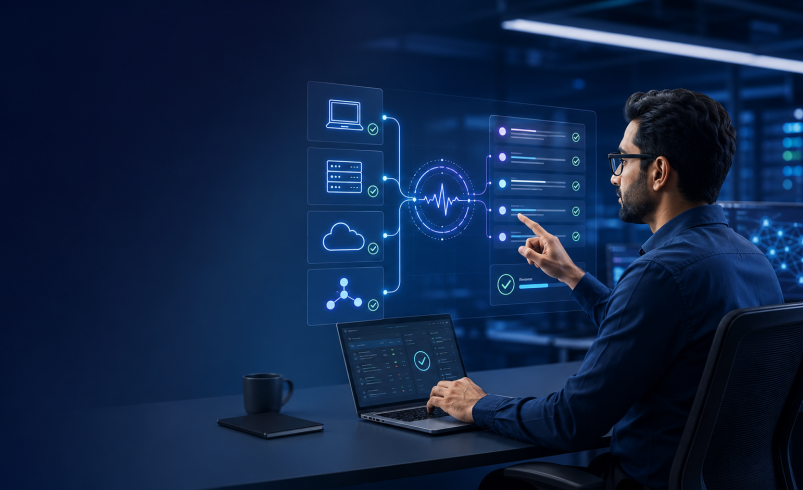
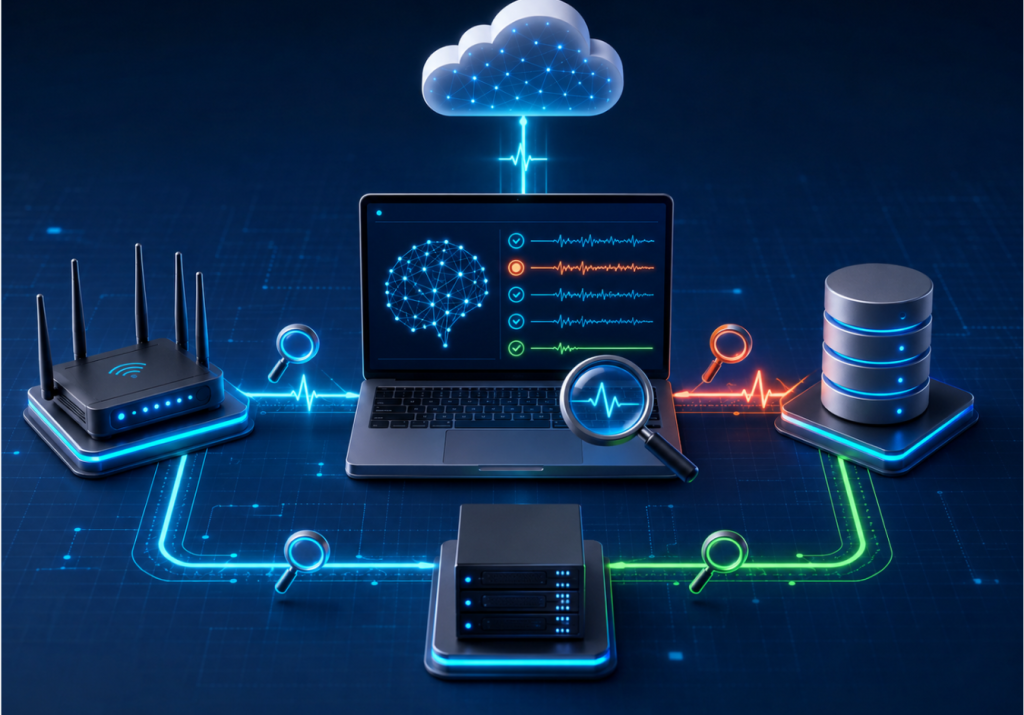
In the case of troubleshooting tools powered by AI, when linked appropriately to monitoring systems, an error message can be correlated with recent software updates, device changes, network events, or other similar events. A probable cause and recommended next step are provided to the technician rather than starting every investigation with a blank slate.
This does not mean that all the diagnoses would be right. It does however save on time taken to collect simple information and test out apparent possibilities.
Active Support, rather than Reactive Support.
Traditional support is typically commenced when an application has ceased to work. AI can assist companies in detecting the red flags before users get affected by a major disruption.
As an example, an AI system can recognize recurring crashes of applications, decreased storage space, high or low device temperatures, unsuccessful logins, or unusual network latency. It can notify the IT team, prescribe preventive maintenance or automatically do a low-risk action based on company policy.
In this model, AI-controlled troubleshooting devices enter into an early-warning system. Instead of letting dozens of employees report the same issue, the support team can start investigating the pattern when the initial warning signs are seen.
The user experience can also be enhanced by proactive support. The workers will have a reduced chance of work loss, fewer customers will suffer service interruptions and technicians will waste less time attending to emergencies that can be avoided.
Improved Self-Service to users.
Numerous support requests are repeatable, like lost password, locked accounts, software installations, connectivity problems, or configuration problems. An intelligent AI assistant will be able to give tailored instructions 24 hours a day, even when the business is not operating.
This benefit is not only 24-hour availability. The system will be able to vary its instructions to the device, operating system, permissions and the stage in the troubleshooting process of the user. It may also be used to justify why a certain action is required rather than give a lengthy, generic checklist.
In the case of businesses, this can help decrease simple Level 1 tickets that are brought into the help desk. To users, it translates to immediate help without having to wait in a queue of support. In case self-service fails to address the issue, the entire history of conversation and diagnostic can be sent to the technician.
The ways in which AI-based troubleshooting tools can help technicians are described.
The rise of AI does not imply that all IT support jobs will go away. Artificial intelligence in most organizations is emerging as a helper to perform routine tasks as technicians are charged with the responsibility of making decisions, communicating, security, and complicated repairs.
An AI assistant will be able to sort incoming tickets, determine urgency, detect duplicates, gather device information, and propose documentation. It might also produce a brief overview of all the efforts that the user has already made. This will avoid the disappointing process of rephrasing the same information to the users following escalation.
Also, less-experienced technicians can have the support of AI-powered troubleshooting tools that will suggest diagnostic procedures and provide a rationale. This can enhance uniformity throughout the support department and minimize reliance on expertise of only one or two older workers.
The experienced specialists also gain. When automated systems handle their routine tasks, they are able to concentrate on infrastructure breakdowns, cyber attacks, software conflicts that are uncanny and long-term gains.
Significant Risks and Limitations.
In spite of the advantages, AI support systems present risks which companies have to handle. When a problem is presented to AI, the latter may fail to comprehend it, suggest an inappropriate step, or come up with a solution that seems truthful but is false. An error in account permissions, security configurations, data erasure, or infrastructure used in production can cause a much bigger incident.
Another concern is privacy. Employee names, device identifiers, configuration, customer records or business secrets can be found in troubleshooting information. Organizations need to know what information the AI system gathers, the processing places, the duration that the data is stored, or training the model.
Control over access is also crucial. Unlimited power should not be given to an assistant who can restart services or change accounts. Any action must be done in accordance with the principle of least privilege, verify the identity, and leave an audit trail.
Trustworthy AI agents are also becoming the subject of increased attention by international organizations. In July 2026, the International Telecommunication Union declared a project dedicated to accountability, identification, and purposeful human management of autonomous AI systems.
Human Escalation is Still Important.
An effective AI support plan must have an avenue to human help. Users must not get stuck in an automated dialogue when the system cannot comprehend their issue or resolve it.
The cases with cybersecurity, possible data loss, frequent failed repairs, accessibility needs, users with a high level of emotions, or systems of great importance to the business must be escalated promptly. Situational awareness, empathy, accountability, and creative problem-solving are aspects that human technicians deliver and can be effective even when automation is not always effective.
The best support model is thus hybrid. Troubleshooting assistance is done by AI-powered tools when there is high volume, low-risk work, and when making an important choice, people are in charge of handling more complex work.
Training a Support Team of AI.
Thanks to organizations, the limited and measurable implementation should be their starting point. Initial points of entry are password help, software help, ticket grouping, case summarization and knowledge-base search.
The business needs to revise its documentation before its deployment since an AI assistant cannot give any credible responses based on inaccurate or old information. Teams must also specify what actions are automated or should be approved or human-controlled.
The number of automated conversations is not the only measure that ought to be used to gauge performance. Some of the useful indicators are resolution accuracy, repeat contacts, escalation quality, user satisfaction, mean time to resolution, security incidents, and a percentage of cases reopened with an AI-generated solution.
Future of Tech Support.
The technical support of 2026 is shifting beyond just conversation bots to AI agents capable of reasoning over information approved by the system, orchestrating work processes, and executing limited functions. The Ask Intel assistant created by Intel based on the Microsoft Copilot Studio is an example of this change as it provides troubleshooting advice, warranty, case creation, and human agent escalation.
The value of AI-powered troubleshooting tools will become long-term, with reliability as a factor instead of novelty. The most benefiting businesses will be those that integrate correct knowledge, effective security measures, open automation, and proficient human technical support.
Artificial intelligence will not help to eradicate all technical issues or to decrease the existence of skilled support specialists. It will alter the way problems are identified, researched and solved. Applied wisely, AI-powered troubleshooting tools can speed up, simplify, enhance, and be more proactive in technology support; human experts will have time to focus on the cases when their skills are most needed.